

Profile Pipe Trusses for Canopies: A Complete Guide to Selection, Calculation and Installation
Published September 2026
A canopy at a country house or in front of a garage is a structure that only looks simple at first glance.
When you need to cover a span of 4–5 meters or more, an ordinary beam is no longer up to the job: it is either too heavy or starts to sag. This is where a truss comes in — a lattice structure that uses less metal yet provides much greater stiffness than a solid beam.
As a manufacturer of profile pipe, we care about helping our customers choose the right solution. In this article, we cover everything from choosing a truss design to common installation mistakes.
What a truss is and why you need one
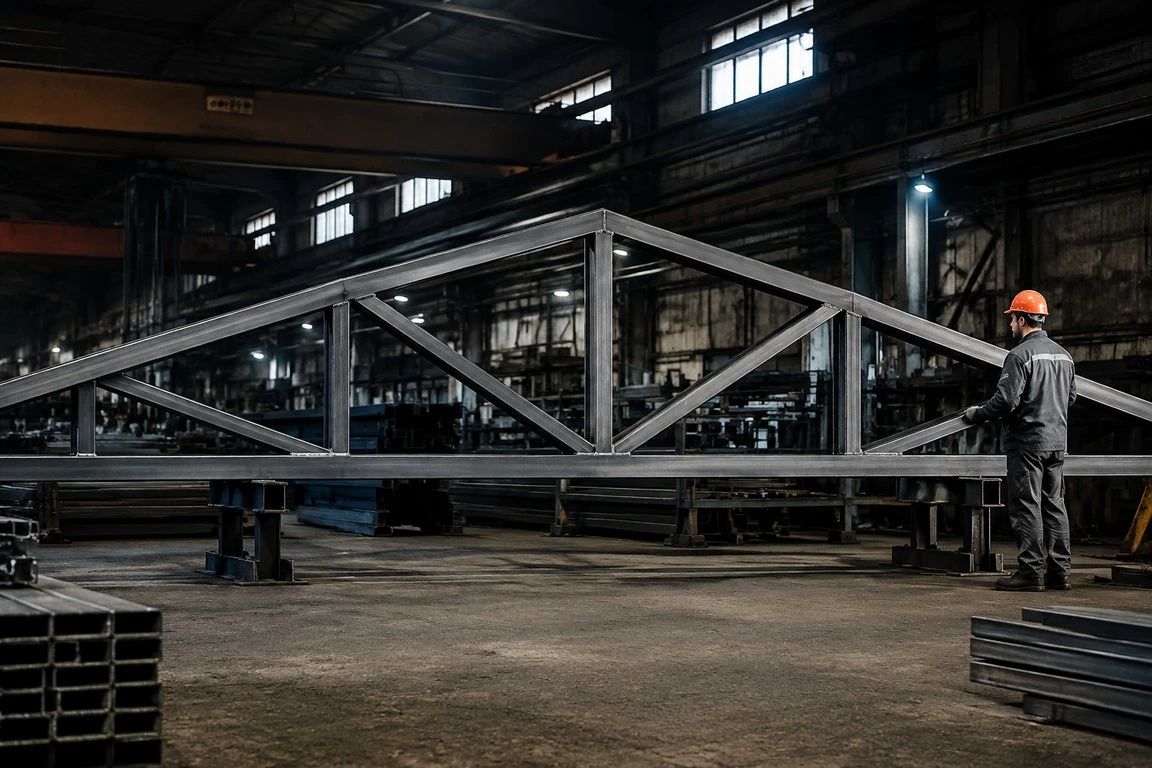
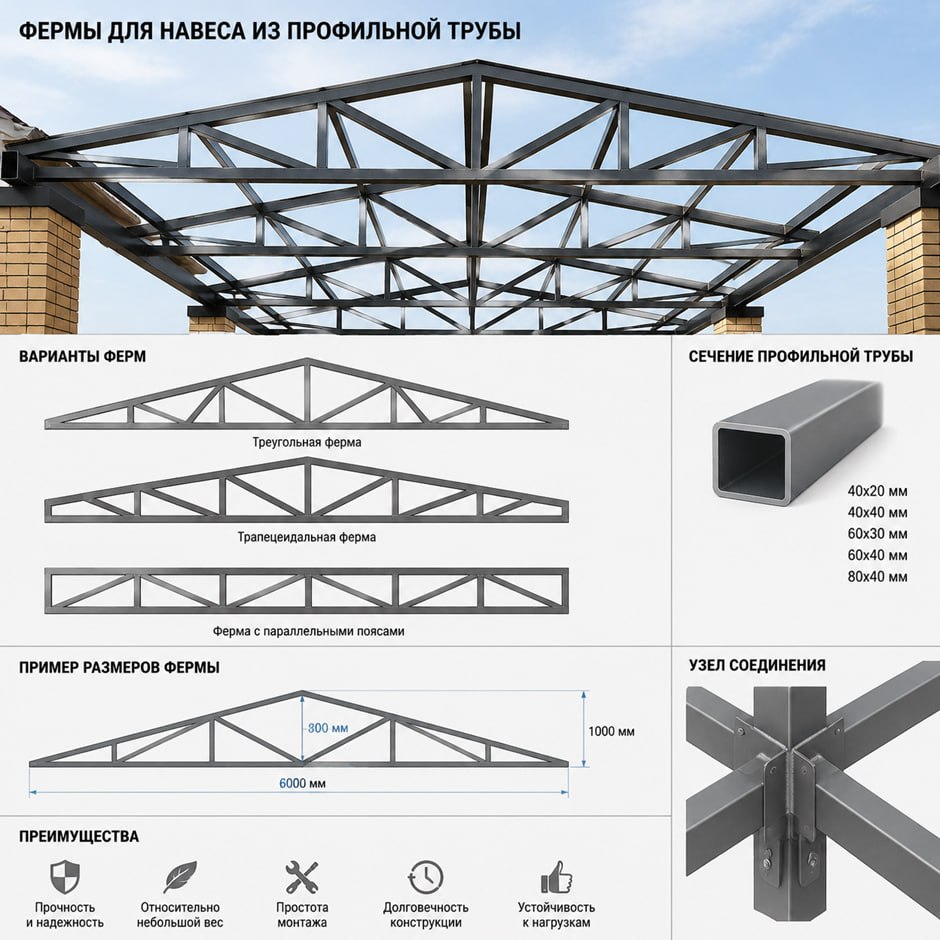
A truss is more than just a few pipes welded together. It is a structure made up of a top chord and a bottom chord connected by verticals and diagonals. This lattice works as a single system: the top chord carries the load from the roofing and snow (it works in compression), the bottom chord holds the truss geometry (it works in tension), and the diagonals transfer forces between them.
When a truss is better than an ordinary beam:
- the span exceeds 4–5 meters;
- the canopy will be covered with profiled sheeting, polycarbonate or other sheet roofing;
- there is a risk of snow load;
- the structure has to withstand wind loads;
- it is important to reduce weight compared with a solid beam.
Put simply, a truss lets you cover a wide opening without intermediate supports, saving metal while keeping the structure strong.
Main types of canopy trusses
Choosing the truss design is the first step, and it determines both material consumption and how complex the truss is to make. Let’s look at four main types.
Mono-pitch trusses
The simplest option: a structure that slopes in one direction. It is often fixed to a building wall, with one side resting on the wall and the other on posts. It suits small canopies and is economical and easy to make. The downside: it gives less protection from sideways rain and snow.
Dual-pitch trusses
They have a ridge in the middle — the classic triangular or trapezoidal shape. They shed snow and water well and withstand high wind loads. They need more metal and more complex joints, but give more usable space under the roof.
Arched trusses
An attractive choice, especially popular for polycarbonate canopies. They look light and modern. However, they require special pipe-bending equipment (a pipe bender) and accurate calculations to keep the pipe walls from deforming during bending. They are harder to make, but look very impressive.
Triangular and trapezoidal
Triangular trusses are good for steep slopes and drain water well, but they need more height. Trapezoidal trusses leave more space under the ceiling and are often used for flat mono-pitch canopies.
Tip: before ordering metal, be clear about the span you are covering, how many trusses will stand along the length of the canopy, what roofing will go on top and where the water will drain. If these questions are not settled in advance, the pipe may arrive in the right size, but parts will have to be reworked on site.
How to choose profile pipe for a truss
Section: square or rectangular?
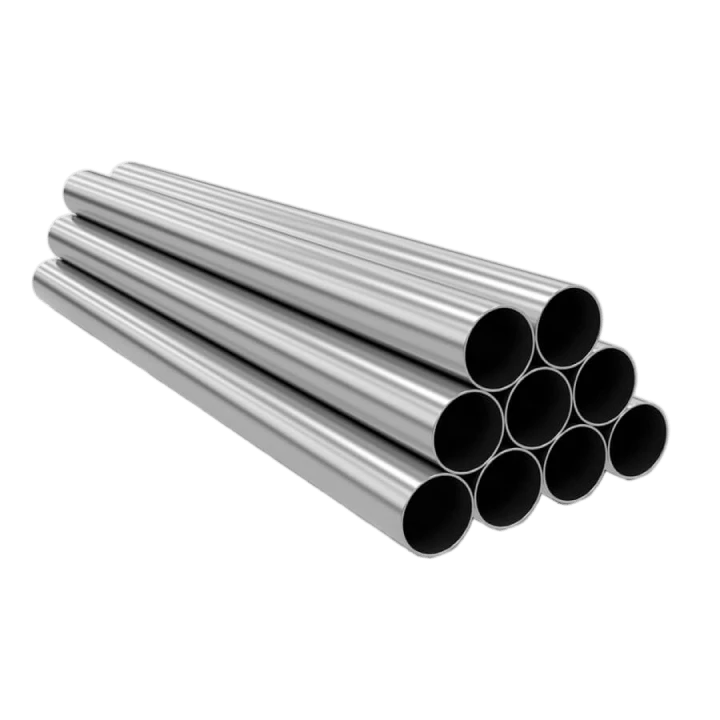
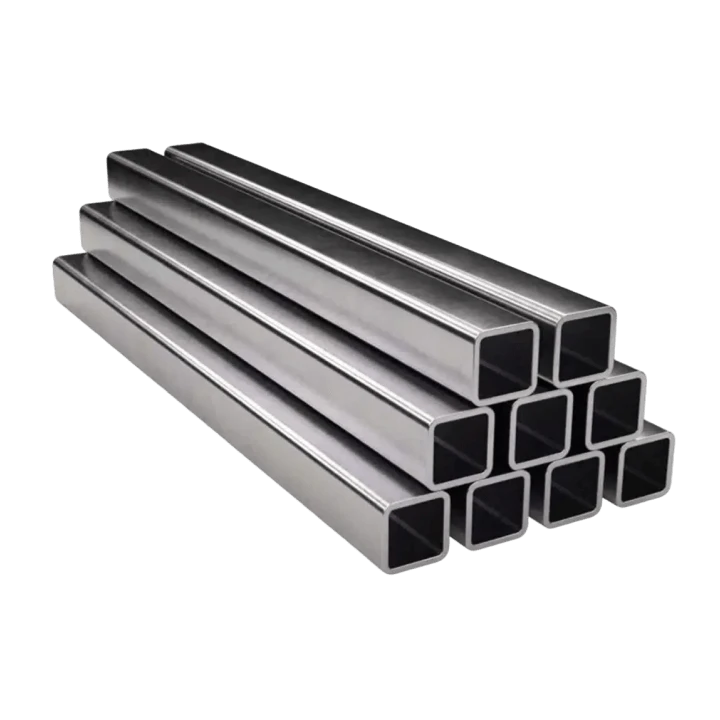
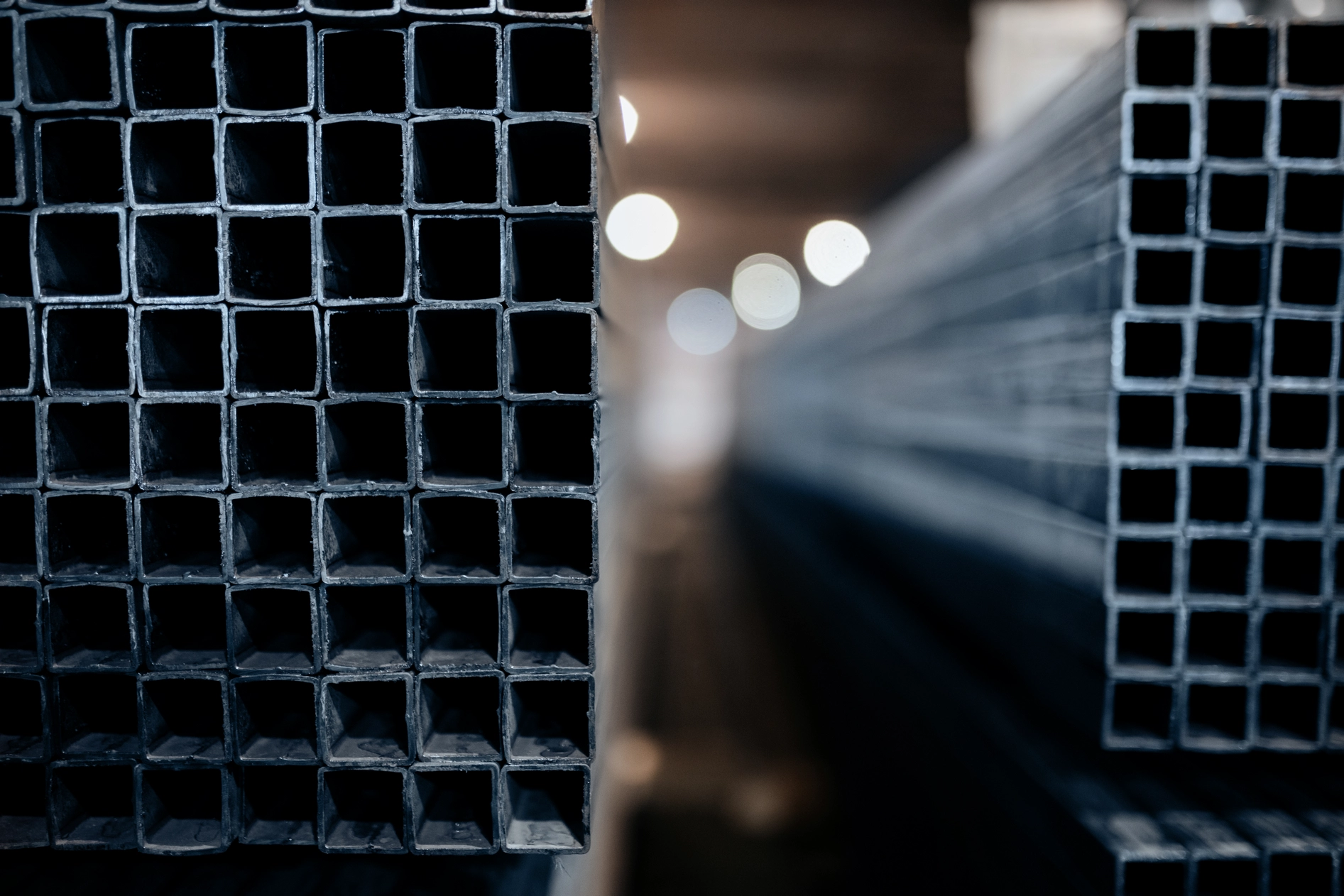
For the top and bottom chords on spans of up to 6–8 meters, square pipe is the most common choice — for example, 60×60×3 mm or 80×80×3 mm. Why square? Its moments of inertia about both axes are equal, so it resists bending equally well no matter which direction the load comes from.
Rectangular pipe (for example, 60×40×2 mm) is often used for diagonals and verticals, as it is easier to fit into the truss joints. For large spans (over 6 meters), a rectangular section in the chords gives greater stiffness in the required plane.
Important: a hollow section pipe has much higher resistance to torsion and bending in different planes than a channel or an angle. This is critical for a truss that works in bending.
Wall thickness: too thin bends, too thick is heavy and expensive
This is where many people go wrong: they take 80×80 pipe with a 4 mm wall “just to be safe”, while for the same span 2.5–3 mm is often enough with a well-designed layout.
Practical guidelines:
- For the chord of a truss with a 6 m span, 60×60×2.5 pipe is often a workable option.
- For light canopies (carports, gazebos), 2–2.5 mm is enough.
- For heavy loads (snow, commercial facilities), the wall should be at least 3 mm.
But there is an important caveat: pipe that is too thick means an overspent budget and extra load on the supports. Pipe that is too thin (1.5–2 mm) can “burn through” during welding and sag in winter.
Steel grade and corrosion protection
St3sp structural steel or its equivalents are usually used. But if the canopy stands in the open air, protection becomes the top priority.
There are two main options:
- Galvanized pipe is the best choice for a humid climate or when the canopy adjoins a house. In regions with high humidity, ordinary black steel starts to rust as early as the installation stage.
- Powder coating is the premium option: polymer powder is applied electrostatically and cured in an oven at 180–220°C. The result is a seamless, wear-resistant coating that withstands UV light and scratches and lasts up to 15–20 years.
Important: if you use galvanized pipe, ordinary primers for black steel will not work — you need special products “for galvanized surfaces”.
Structural members and lattice types
A truss is more than a set of pipes. Each member has its own job:
| Member | What it does | What to check when ordering |
| Top chord | Carries the load from the roofing, snow and battens | Pipe section, straightness, length |
| Bottom chord | Holds the truss geometry, works in tension | Straightness, joints |
| Verticals | Connect the top and bottom chords | Equal length, squareness |
| Diagonals | Transfer forces in a triangulated pattern | Cut angle, tight fit |
| Base plates | Transfer the load to the posts | Thickness, welding |
The main rule is simple: a truss loves triangles. If the diagonals are placed at random and the joints do not meet at clear points, the metal may be wasted — the structure will not gain stiffness.
Lattice types:
- Triangular — the most economical, with the fewest joints and the shortest total member length.
- Diagonal — when the verticals have to resist large forces.
- Cross (X-braced) — for frames loaded in both directions.
- Subdivided (sprengel) — when the main load falls on the top chord.
Choosing the right lattice can save up to 15–20% of the metal without any loss of strength.
Load calculation and design
For critical structures — commercial facilities, canopies over vehicles, places where people walk nearby — a calculation is mandatory.
Regulatory documents
Trusses must comply with state standards:
- SNiP II-23-81 and its updated edition SP 16.13330.2017 “Steel Structures”.
- SNiP 2.01.07-85 (loads and actions) — SP 20.13330.2016 “Loads and Actions”.
- GOST 23118-99 (general specifications for steel structures).
What to take into account in the calculation:
- Permanent loads — the weight of the roofing (profiled sheeting, polycarbonate).
- Variable loads — snow and wind loads, which depend on the region.
- Additional loads — the weight of a person during repairs and snow clearing.
An important tip: many people make the mistake of considering only the vertical load. Wind can create torsional moments, especially on mono-pitch structures. We recommend adding a 20% margin to the code values — this protects against abnormal precipitation.
Material allowance
When buying pipe, always add 5–10% to the calculated length. Even with a good drawing, there will be trimming, angle fitting and marking errors. This is especially important for trusses with many short parts and diagonal braces.
Fabrication and installation
Welding
The main joining method for permanent structures. Experienced welders know that a good truss is welded slowly, with mandatory pauses to let it cool.
Key rules:
- Weld in a staggered sequence so as not to overheat thin-walled pipe.
- Overheating the metal is the main enemy of strength. When working with thin-walled sections, use an intermittent arc.
- Do not leave the structure in a draft right after welding — sudden temperature changes make the weld brittle and cause microcracks.
Bolted connections
These are used for demountable structures. They require tightening control (use torque wrenches or impact wrenches), and the weakening of the pipe section by bolt holes must be taken into account.
Geometry control
Checking diagonals and planes is critical. A 2 cm error at the plant can make installation on site much harder. We once had trusses arrive from a plant with a geometric deviation of just 2 cm — and that was enough to complicate installation.
Protection after welding
Mandatory post-treatment steps:
- Mechanical cleaning — removing slag and scale from the welds and degreasing the surface.
- Priming — applying an alkyd or epoxy anti-corrosion primer. Pay special attention to hard-to-reach areas: inside corners and joints.
- Topcoat — alkyd enamels (affordable), polyurethane coatings (for industrial facilities) or powder coating (the premium option).
Important: do not paint the truss right after welding or in damp weather. The metal must be completely dry and the air temperature must be at least +5°C.
Common mistakes and how to avoid them
- “I’ll weld it by eye” leads to deformation and a sagging roof. A truss is an engineered structure, not a set of pipes.
- Skimping on pipe for the diagonals reduces overall stiffness. Diagonals are not a “minor detail” — they transfer forces between the chords.
- Using untreated black steel in a humid climate means corrosion starts within a single season. In coastal areas, it is better to plan for galvanizing or powder coating from the start.
- Ignoring wind load on mono-pitch structures — wind can create a torsional moment that was not accounted for.
- Buying exactly the calculated amount of pipe with no allowance — work can stop because of a single missing piece. Add 5–10% on top of the calculation.
A profile pipe truss is the ideal balance between strength and metal savings. The right choice of design, pipe section and lattice is the key to a durable and safe canopy. A competent calculation that accounts for snow and wind loads, quality welding and proper anti-corrosion protection extend the service life of the structure to 15–20 years.
In our catalog you will find pipes of any section and wall thickness — from 40×40 square to 80×40 rectangular and larger. Our managers will help you calculate the amount of metal your project needs, including an allowance for trimming. Get in touch — we will find the best solution for your task!
News
All news
30.09.2026
Hot-rolled and cold-rolled strip: what is the difference and which to choose
06.02.2026
Railway siding services in Temirtau: receiving, unloading, storage
06.02.2026
Sheet Cutting from Coil: Tolerances, Lead Times, Error-Free Specs
05.02.2026